A founder deciding where to raise their first institutional round often assumes the "top" of the company is wherever the operating business already sits — the Lebanese SAL that signs client contracts, or the UAE mainland LLC that employs the team. That assumption is usually wrong, and unwinding it after an investor's name is already on the cap table is far more expensive than getting it right at the outset.
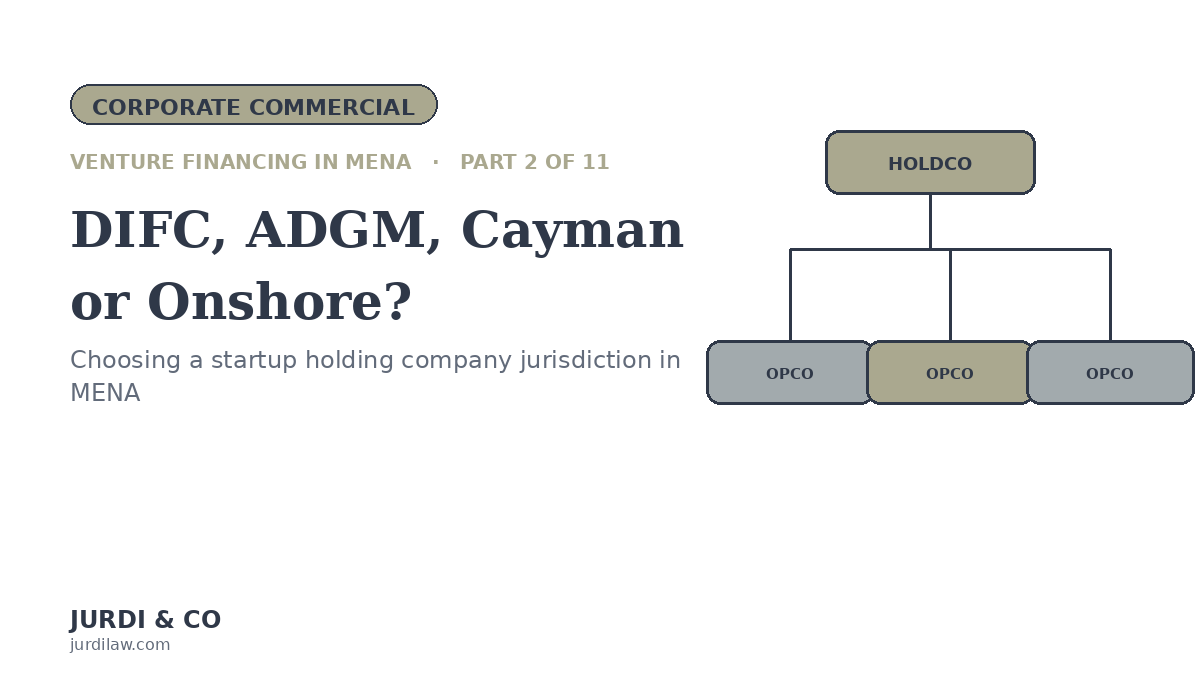
The short answer: Most MENA startups raising institutional venture capital place a separate holding company above the operating business — commonly in the DIFC, ADGM, or the Cayman Islands — because these jurisdictions offer common-law predictability and share-class flexibility that international investors already recognise. The operating company then becomes a subsidiary of the holding company, not the investment vehicle itself.
This is Part 2 of our 11-part series on the legal architecture of venture financing in MENA. Part 1 explained why capital structure matters more than valuation — this part covers the jurisdictional question that usually comes right after.
Why the Operating Entity Isn't Usually the Investment Vehicle
An operating business with a growing footprint across MENA — or even one growing inside a single country — presents institutional investors with a coordination problem. Equity issued directly at the operating-company level may not carry the same governance predictability, or the same body of tested case law, as equity issued through a holding vehicle incorporated somewhere with a well-developed, frequently litigated commercial law. A holding company sitting above the operating business becomes the actual locus of the investment: the preferred shares are issued there, the shareholders' agreement is governed by that jurisdiction's law, and the operating subsidiaries become assets held through the holding structure rather than direct counterparties to the investor.
DIFC and ADGM: Common Law Inside the UAE
The Dubai International Financial Centre and Abu Dhabi Global Market both offer something the rest of the UAE historically couldn't: a full common-law legal system, run independently of onshore civil law, with English-language courts.
Under the DIFC's Companies Law (DIFC Law No. 5 of 2018), private companies benefit from considerable flexibility — no minimum share capital, no requirement for shares to be fully paid up, and a Prescribed Company regime that lets an investor hold shares or IP through a DIFC entity without needing physical office space. In practice, DIFC-structured venture deals commonly use SAFEs, convertible notes, and multi-class share structures, with disputes falling under the DIFC Courts rather than UAE federal civil courts.
ADGM offers a comparable proposition through its Companies Regulations 2020. Its Special Purpose Vehicle regime is specifically built for holding structures — an ADGM SPV can issue multiple classes of shares, including fractional shareholding, and standard venture mechanics like drag-along, tag-along, and golden shares are directly enforceable under ADGM's own common-law framework. The main practical difference between the two is largely geographic and regulatory-culture: DIFC sits in Dubai and is overseen by the DFSA; ADGM sits in Abu Dhabi and is overseen by the FSRA. Neither is categorically "better" — the right one usually follows where the founders, the board, or the lead investor are actually based.
Cayman Islands: Still the Default for Cross-Border Capital
Despite the UAE now having two credible common-law free zones of its own, the Cayman Islands exempted company — formed under the Companies Act (As Revised) — remains the most common holding vehicle globally for venture-backed startups, and that includes a meaningful share of MENA companies raising from international funds. The reasons are less about the UAE's shortcomings and more about investor familiarity: Cayman company law, its no-direct-corporate-tax treatment, and its English common-law foundation (with final appeal to the Privy Council in London) are what most international VC fund documents, standard-form term sheets, and fund counsel are already built around. A MENA startup raising a round led by a US or European fund will frequently find the investor's own template term sheet already assumes a Cayman (or Delaware) structure, which can make it the path of least resistance even when a DIFC or ADGM entity would work just as well on the merits.
What the UAE's 2025 Reform Actually Changes — and Doesn't
As we noted in Part 1, Federal Decree-Law No. 20 of 2025, which amended Federal Decree-Law No. 32 of 2021 on Commercial Companies, now permits UAE mainland LLCs to issue multiple share classes with distinct voting, dividend, and liquidation rights, alongside a statutory basis for drag-along and tag-along rights. This is a genuinely significant shift in principle.
In practice, the detail matters: several law firms tracking the reform have noted that the equal-treatment-of-shares default remains in place until the UAE Cabinet issues the implementing resolutions the amendment contemplates for multi-class LLC structures. In plain terms, the door has been legislatively opened, but the specific mechanics for walking through it, at the mainland LLC level, are not yet fully operational as of this writing. For now, that means DIFC, ADGM, and Cayman remain the more immediately usable options for a founder who needs a tested preference structure today, while the mainland route is one worth revisiting as the implementing rules are issued.
Lebanon: No Local Equivalent, So Founders Flip
Lebanon does not have a DIFC- or ADGM-style onshore common-law free zone. It does have an offshore company regime under Legislative Decree No. 46 of 1983 (as amended in 2008 and 2018), but that vehicle's purpose is legally restricted to activities conducted outside Lebanese territory — it cannot itself be the entity operating a Lebanon-based business, and so it isn't a substitute for the DIFC/ADGM/Cayman holding-company role in the way founders sometimes assume.
The practical pattern for a Lebanese startup raising institutional capital, particularly from international investors, is a "flip": a new holding company is incorporated in the Cayman Islands (or occasionally Delaware), and the existing Lebanese SAL becomes an operating subsidiary underneath it. This doesn't make the Lebanese entity irrelevant — the preferred-share mechanics introduced for Lebanese SALs under Commercial Law No. 126 of 2019 remain useful if the operating company itself ever issues its own share classes — but for the primary institutional round, the holding company almost always sits offshore.
How Founders Should Actually Decide
There is no universally correct answer here, and founders are generally better served evaluating the choice against their own specific facts rather than defaulting to whatever the first investor's lawyer proposes:
Where is the investor base likely to sit? Regional angels and GCC family offices are often comfortable with a DIFC or ADGM structure. International funds frequently default to Cayman or Delaware regardless of where the company operates.
What does the follow-on path look like? A structure that suits a seed round from regional investors may need to be revisited if a later round is led by a fund with its own jurisdictional requirements — a point we'll return to in Part 5 when we cover dilution and pro rata rights.
What is the actual cost of maintaining the structure? A holding company adds a genuine layer of registered agents, filings, and — depending on the jurisdiction — economic substance requirements, which is a real ongoing cost, not just a one-time legal fee.
The Jurdi & Co Perspective
In our corporate commercial practice, we regularly advise on UAE free zone structures and the practical trade-offs between onshore and free zone entities for businesses operating across the region. The jurisdictional question in a venture financing is a more specialised version of a question we see constantly in commercial structuring generally: which jurisdiction's law do you actually want governing the relationship if something goes wrong, and is that the same answer as which jurisdiction is cheapest or most familiar to set up in today?
Series Navigation
This is Part 2 of 11. Part 1 — Why Capital Structure Matters More Than Valuation is live; Part 3 will cover preferred equity and the separation between economic rights and operational control.
Frequently Asked Questions
Is DIFC or ADGM better for a startup holding company?
Neither is categorically better — both offer a common-law framework, multi-class shares, and independent courts. DIFC is based in Dubai and regulated by the DFSA; ADGM is based in Abu Dhabi and regulated by the FSRA. The more relevant factors are usually where the founders and board are actually based, and whether a specific investor has a stated preference.
Can a Lebanese startup use a Cayman holding company while still operating from Beirut?
Yes — this is the standard structure for Lebanese startups raising institutional, and particularly international, venture capital. A Cayman exempted company sits at the top as the holding company, and the existing Lebanese SAL continues operating as a subsidiary underneath it.
Does the UAE's 2025 Commercial Companies Law reform mean startups no longer need DIFC, ADGM, or Cayman?
Not yet. While Federal Decree-Law No. 20 of 2025 permits UAE mainland LLCs to issue multiple share classes in principle, the specific implementing resolutions needed to operationalise this were still pending as of this writing, and the default rule of equal treatment among shares remains in place until they are issued. DIFC, ADGM, and Cayman remain the more immediately usable options for a founder who needs a tested structure today.
This article is provided for general informational purposes only and does not constitute legal advice. It does not create a lawyer-client relationship between the reader and Jurdi & Co. Laws referenced are current as of the date of publication and may be subject to change; readers should seek independent legal advice before acting on any information in this article.