Of the four economic components of preferred equity we introduced in Part 3, the liquidation preference is the one most likely to actually determine what a founder walks away with — particularly in an exit that falls short of the outcome everyone hoped for when the round was priced.
The short answer: A liquidation preference is a contractual right for preferred shareholders to receive a specified amount — typically the original investment, or a multiple of it — before common stockholders (founders and employees) receive anything in a sale or wind-down. A standard 1x non-participating preference is designed purely as downside protection. Higher multiples, participation rights, and preference stacking across multiple rounds are where the mechanism starts to determine far more than just the downside case.
This is Part 4 of our 11-part series on the legal architecture of venture financing in MENA.
How a Liquidation Preference Actually Works
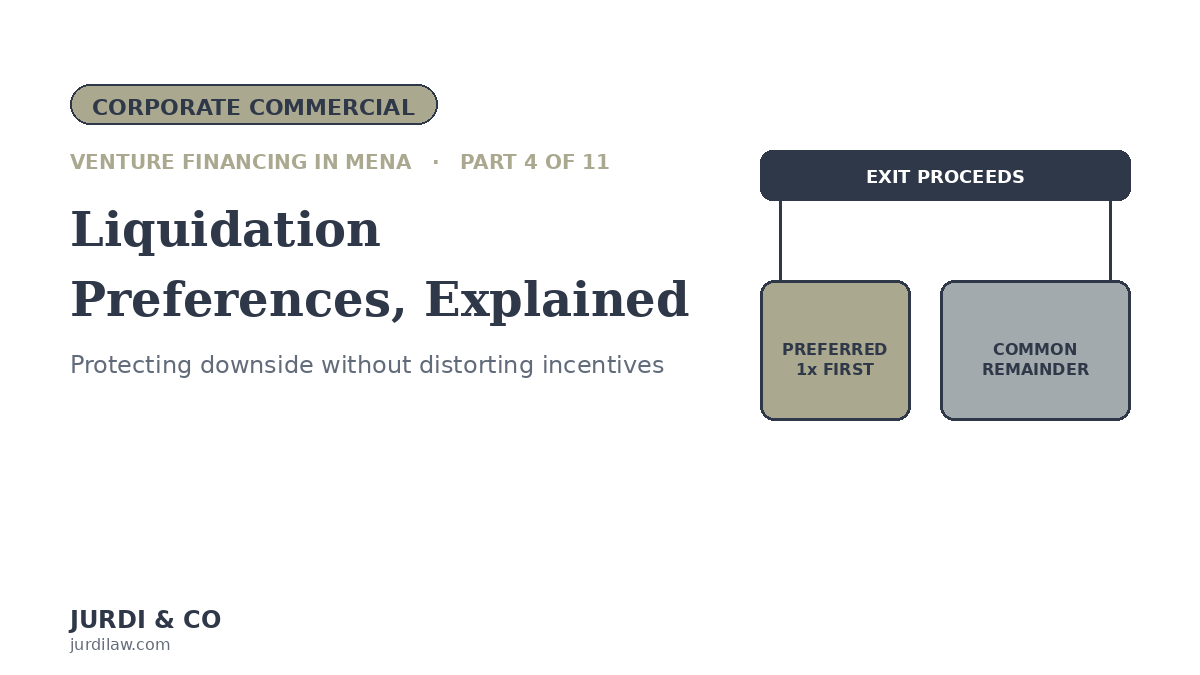
The mechanic itself is simple: on a qualifying sale or liquidation, the preferred shareholder receives its liquidation preference — commonly one times (1x) its original investment — before any proceeds go to common stockholders. If the exit value comfortably exceeds this amount, the preferred holder typically converts to common instead and takes its pro-rata share, since that produces a larger return. The preference only actually bites in a modest exit — one where the company has survived and generated some value, but not the outsized outcome the investment was priced against. In that scenario, the preference exists specifically to make sure the investor recovers its capital before founders and employees see anything.
A simplified example makes this concrete. Say an investor puts $2 million into a company at a $10 million post-money valuation (20% ownership), with a standard 1x non-participating preference. If the company later sells for $30 million, the investor's 20% as-converted share ($6 million) comfortably exceeds its $2 million preference, so it converts to common and takes the $6 million. But if the same company sells for only $6 million — a real outcome, not a hypothetical failure — the investor takes its $2 million preference off the top first, leaving $4 million for all common stockholders combined, rather than the $1.2 million (20% of $6 million) the investor would have taken on a purely pro-rata basis. The preference has done exactly what it was designed to do: protect the investor's capital in a modest outcome, at the direct expense of what common stockholders receive in that same scenario.
Where It Distorts Incentives: Stacking and Participating Preferred
Two variables turn a simple downside-protection mechanic into something that can dominate the entire distribution of exit proceeds.
Preference stacking happens once a company has raised multiple rounds, each carrying its own liquidation preference. In an exit priced below the combined value of all outstanding preferences, common stockholders — including founders and the employee option pool — can receive little or nothing, even in an exit that looks reasonably successful on an unadjusted valuation basis.
Participating preferred compounds this further. A participating preferred holder receives its liquidation preference and then also shares, pro-rata with common stockholders, in whatever proceeds remain — informally known as "double-dipping." This meaningfully increases the investor's return in almost every exit scenario, directly at the expense of what founders and employees take home in the same scenario.
What's Actually Standard Today: Global vs MENA Market Practice
Here the data tells a genuinely useful, and somewhat divergent, story depending on which market you're benchmarking against.
In the United States, Cooley LLP's Q2 2025 Venture Financing Report — covering 238 reported financings — found that 98% of deals carried a 1x liquidation preference and 95% used non-participating preferred stock. In other words, participating preferred is now close to off-market in mainstream US venture deals; 1x non-participating is the overwhelming default.
MENA market practice tells a different story. According to a widely referenced founder-facing breakdown of MENA term sheets, a meaningful share of investors across MENA and Pakistan still opt for a participating 1x liquidation preference, reflecting the higher risk premium many regional investors attach to early-stage deals, even though non-participating 1x is increasingly the norm among more sophisticated regional and international investors active in the market. That gap matters in practice: a founder benchmarking a MENA term sheet against generic "market standard" commentary written for a US audience may be comparing their deal against a norm that doesn't actually describe the market they're raising in.
Modeling Across Exit Scenarios
The practical lesson from both the stacking and participation issues is the same: a liquidation preference multiple should never be evaluated in isolation from the rest of the capital structure. Before agreeing to a specific multiple or participation right, it's worth explicitly modelling proceeds across a range of outcomes — a strong exit, a modest exit, and a down round — incorporating the full stack of preferences from any prior rounds, rather than assessing the new term only against the valuation the current round implies. A multiple that looks unremarkable in isolation can produce a materially different outcome once layered on top of an existing preference stack, which is precisely the scenario in which this term does its real work.
The Jurdi & Co Perspective
Liquidation preference terms are only as good as the documents that implement them — the shareholders' agreement and the company's constitutional documents need to reflect the negotiated waterfall precisely, including how it interacts with any existing preference stack from prior rounds. This is the same drafting discipline that applies across our corporate commercial work generally: a clause that reads correctly in isolation is not the same as a clause that behaves correctly once layered against everything else already in place.
Series Navigation
This is Part 4 of 11. Previously: Part 1, Part 2, and Part 3 — Preferred Equity. Next: Part 5 covers dilution, pro rata rights, and the option pool.
Frequently Asked Questions
What is a 1x non-participating liquidation preference?
It means the preferred investor receives the higher of either (a) its original investment amount back, or (b) its pro-rata share of proceeds as if converted to common stock — but not both. This is currently the dominant structure in US venture deals, appearing in roughly 95% of financings tracked by Cooley LLP in Q2 2025, and is increasingly common among sophisticated investors in MENA as well.
Is participating preferred more common in MENA than in the US?
Based on available market commentary, yes, to a meaningful degree — a notable share of MENA and Pakistan-based investors have historically favoured participating 1x preferred, reflecting a higher perceived risk premium in early-stage regional deals, compared to a US market that has moved heavily toward non-participating structures. This is a generalisation about market tendencies, not a rule; specific terms are always deal- and investor-dependent.
How does preference stacking affect founders in a later exit?
Each financing round typically adds its own liquidation preference on top of previous rounds. In an exit priced below the combined total of all outstanding preferences, preferred stockholders across all rounds may need to be paid in full before common stockholders — including founders and the employee option pool — receive any proceeds at all, even if the exit looks reasonably successful before accounting for the preference stack.
DISCLAIMER: This article is provided for general informational purposes only and does not constitute legal advice. It does not create a lawyer-client relationship between the reader and Jurdi & Co. Laws referenced are current as of the date of publication and may be subject to change; readers should seek independent legal advice before acting on any information in this article.