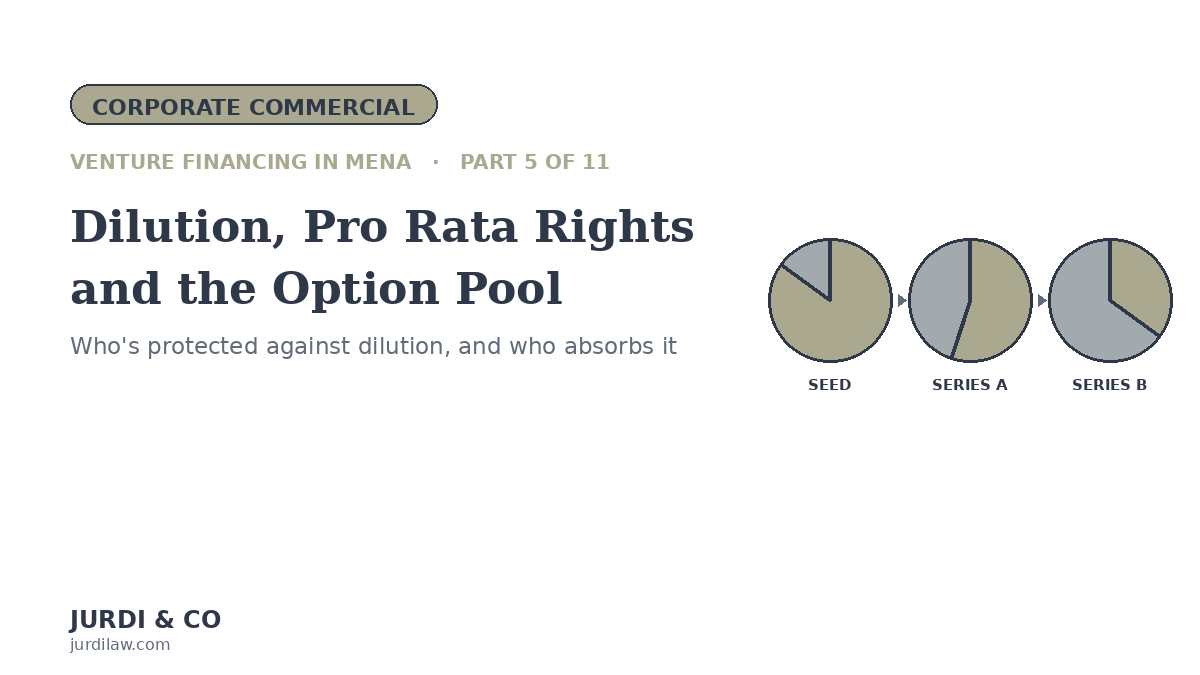
Every financing round dilutes existing shareholders — that part is simple arithmetic, not a negotiation. What's actually negotiated is who is protected against that dilution, to what degree, and through which mechanism. Three tools do most of the work: pro rata rights, anti-dilution protection, and the option pool, and founders regularly confuse the first two even though they operate completely differently.
The short answer: Pro rata rights let an existing investor buy more shares in a future round to maintain its ownership percentage. Anti-dilution protection adjusts an investor's conversion price if a future round is priced lower, without requiring any new capital. The option pool is equity set aside for future hires, and whether it's created before or after the new investment determines who actually absorbs its dilutive effect.
This is Part 5 of our 11-part series on the legal architecture of venture financing in MENA.
Pro Rata Rights: Preserving Ownership Through Future Rounds
A pro rata right gives an existing investor the option — not the obligation — to purchase its proportional share of a future financing round, keeping its ownership percentage from shrinking as new investors come in. This is straightforward from the investor's side: a fund with real conviction in a company wants to maintain its position through subsequent rounds rather than watching a successful early bet get diluted down to an afterthought by the time of exit. From the company's side, it's a genuine constraint on flexibility — a founder trying to bring in a new lead investor for a later round may find the available allocation reduced by existing pro rata commitments, which is usually resolved through negotiated waivers or reduced allocations rather than simply ignored.
Anti-Dilution Protection: A Different Mechanism With a Different Purpose
Anti-dilution protection is often confused with pro rata rights, but the two do different jobs. A pro rata right lets an investor buy more shares to hold its percentage steady. Anti-dilution protection adjusts the conversion price of shares the investor already holds if the company later raises at a lower valuation — a "down round" — without the investor putting in a single additional dollar.
There are two common formulas. Full-ratchet anti-dilution resets the investor's conversion price down to the new, lower round's price entirely, regardless of how many shares were actually issued in that round — this can produce a large reallocation of ownership away from common stockholders, particularly when the down round is small relative to the adjustment it triggers. Broad-based weighted-average anti-dilution, the far more common structure in institutional venture financing, adjusts the conversion price proportionally to both the new round's price and the number of shares issued, producing an adjustment that's actually proportionate to the real dilutive impact of the down round. Full-ratchet protection is comparatively unusual outside distressed financing situations, and founders should treat a full-ratchet request as a term worth real scrutiny rather than boilerplate.
The Option Pool: Dilution as a Pre-Negotiated Allocation
The option pool — equity reserved for future employee grants, sized as a percentage of the company's fully diluted capitalisation — is where a lot of dilution happens quietly, inside the pricing of the round itself rather than as a separately negotiated term. Founder-facing data suggests the most common option pool size sits between 10% and 15% of the company, with 10% the single most frequent figure.
The mechanic that actually matters is timing. Where an investor requires the pool to be created or expanded before the new investment closes (a "pre-money" pool), the dilutive effect falls entirely on existing shareholders — mainly the founders — before the incoming investor's money is even counted, rather than being shared proportionately between the founders and the new investor. This is sometimes called the "option pool shuffle": an investor can effectively lower the real price they're paying by requiring a larger pre-money pool, even while the headline valuation stays the same.
A short example shows why the timing matters so much. Suppose a company agrees to a $10 million pre-money valuation and a $2 million investment, and the investor requires a 15% post-financing option pool that doesn't yet exist. If that pool is created pre-money, the entire 15% comes out of the founders' existing shares before the new valuation is even applied — the founders' effective pre-money valuation is closer to $8.5 million once the pool is netted out, even though $10 million is the number on the term sheet. If the same pool were instead created post-money, the dilution would be shared proportionately between the founders and the incoming investor. Same headline valuation, same pool size — a meaningfully different outcome for the founders depending on one placement decision most term sheets don't spell out in plain language.
What This Looks Like in a MENA Deal
The mechanics above assume a jurisdiction that can actually support flexible share pricing and conversion adjustments — which, as covered in Part 2, means DIFC, ADGM, Cayman, or (in principle, following the 2025 reform) a UAE mainland LLC once the relevant Cabinet resolutions are issued. We haven't found a published MENA-specific benchmark for typical option pool sizing the way global sources like Carta publish for the US market — worth flagging honestly rather than inventing a regional figure that doesn't exist. In our experience, the underlying mechanics (pre-money vs post-money placement, full-ratchet vs weighted-average) are identical regardless of region; what changes is simply whether the chosen entity's constitutional documents can actually implement them cleanly.
How Founders Should Evaluate These Terms
Model the fully diluted picture, not the headline valuation. A term sheet's stated valuation frequently understates real dilution once the option pool and any anti-dilution adjustments from existing preferred stock are factored in.
Push back on full-ratchet anti-dilution specifically. It's the one variant worth actively resisting rather than accepting as standard, given how disproportionate its effect can be relative to a modest down round.
Size the option pool from an actual hiring plan, not a round number the investor proposes, and understand whether it's structured pre- or post-money before agreeing to a headline valuation.
The Jurdi & Co Perspective
Dilution mechanics only work as intended if the underlying documents — the shareholders' agreement, the company's articles, and any side letters — define the pool, the conversion formulas, and the pro rata mechanics with real precision. This is the same discipline we apply across our corporate commercial drafting generally: a formula that's clear in a term sheet summary can still be genuinely ambiguous once it needs to be applied against an actual, messy cap table.
Series Navigation
This is Part 5 of 11. Previously: Part 1, Part 2, Part 3, and Part 4 — Liquidation Preferences. Next: Part 6 covers board control versus shareholder protection.
Frequently Asked Questions
What's the difference between pro rata rights and anti-dilution protection?
Pro rata rights let an investor buy additional shares in a future round to maintain its existing ownership percentage — it requires the investor to commit more capital. Anti-dilution protection adjusts the conversion price of shares the investor already holds if a future round is priced lower, without any new capital from the investor. They address different situations and are negotiated as separate term sheet provisions.
Should a pre-money or post-money option pool be a red flag for founders?
Not automatically — pre-money pools are still the more common structure in venture term sheets. The issue isn't which structure is used, but whether the size is justified by an actual hiring plan and whether the founder understands that a pre-money pool means the dilution falls on existing shareholders alone, not on the incoming investor.
Is full-ratchet anti-dilution common in MENA venture deals?
Full-ratchet anti-dilution is uncommon in institutional venture financing generally, and there's no indication MENA practice differs meaningfully on this point — broad-based weighted-average remains the standard structure globally. A full-ratchet request is generally worth treating as a term requiring real negotiation rather than a standard clause.
DISCLAIMER: This article is provided for general informational purposes only and does not constitute legal advice. It does not create a lawyer-client relationship between the reader and Jurdi & Co. Laws referenced are current as of the date of publication and may be subject to change; readers should seek independent legal advice before acting on any information in this article.